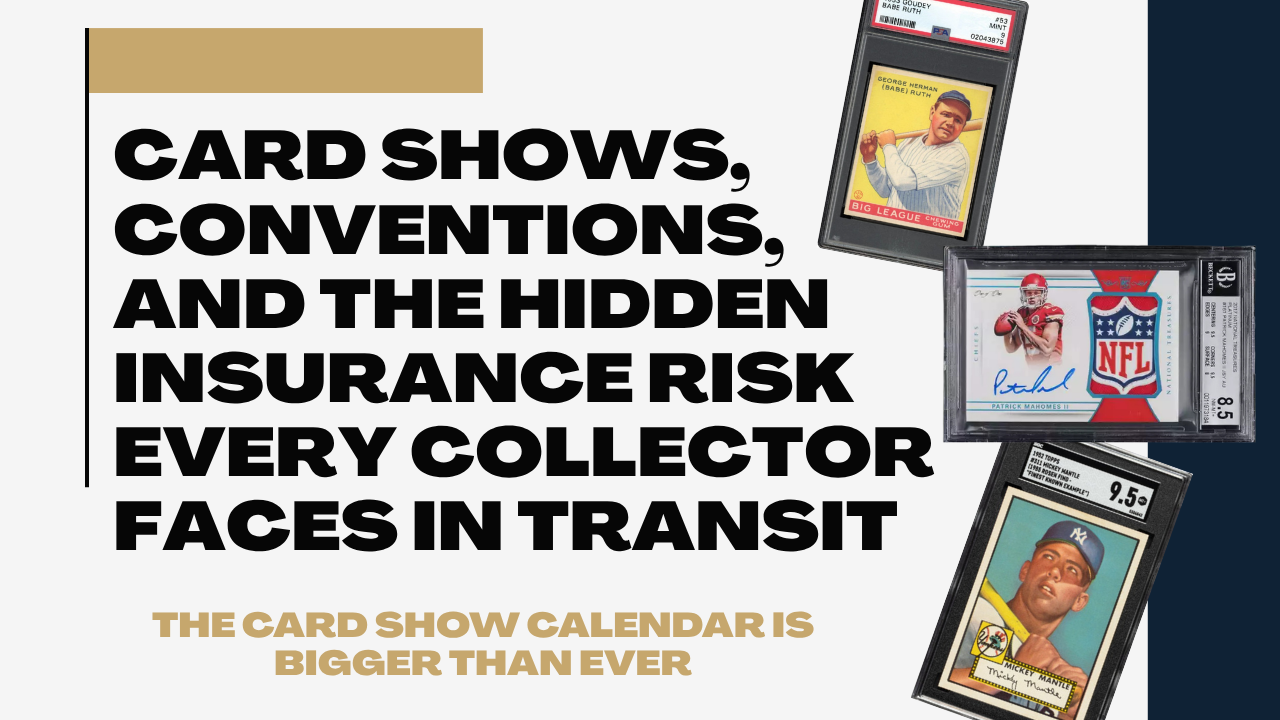
Card Shows, Conventions, and the Hidden Insurance Risk Every Collector Faces in Transit
Independent Insurance Broker · Former Moving Company Owner · Collectibles Enthusiast
The National Sports Collectors Convention draws tens of thousands of collectors to a single convention center every July. In 2025, that meant more than 600 vendors, thousands of buyers, and an untold amount of collectibles wealth moving through the doors of the Donald E. Stephens Convention Center in Rosemont, Illinois — in backpacks, binders, and hard plastic slabs tucked under arms.
Every single one of those collectors assumed, on some level, that their cards were safe.
Most were wrong about the details. Not because shows are dangerous — they're generally well-run, secure events. But because the coverage that protects a card sitting at home in a fireproof safe almost certainly does not cover that same card the moment it leaves the front door.
This is the card show insurance gap. It's one of the most overlooked risks in the hobby, and as shows grow larger, more frequent, and more valuable, it's becoming one of the most important.
The Card Show Calendar Is Bigger Than Ever
What was once a regional circuit of hotel-table shows has evolved into a national ecosystem of major events.
- The National Sports Collectors Convention — July 30–August 3, 2026, Rosemont, IL. 600+ tables, on-site grading, six-figure deals on the floor.
- The Baltimore Card Show — May 16–17, 2026 at Chesapeake Employers Insurance Arena. 250+ tables.
- Courtside Card Show Miami — regularly 300 tables at the Hyatt Regency.
- The East Bay Card Show — June 20–21, Hyatt Regency SF Airport. Sports, TCG, Pokémon, Funko all under one roof.
- The Dallas Card Show — six times a year at the Marriott Dallas Allen Convention Center. Billed as the largest in the U.S.
Beyond these, hundreds of regional shows run year-round in hotel ballrooms, convention centers, and community spaces across every state. The hobby is everywhere now — and that's the problem.
What Happens to Your Coverage at a Show
The cards leave the insured location. Most homeowners policies cover personal property at or near your home. Off-premises coverage is frequently limited to 10% of total coverage, often with separate collectibles sublimits.
The cards enter an environment with elevated risk. Crowded public spaces, cash transactions, temporary displays, and significant physical handling. A card dropped, bent, or scratched is a condition damage claim — handled very differently by most policies than theft or fire.
Custody gets complicated. Buying, selling, trading — cards change hands. If something is lost or damaged while a dealer is evaluating it, whose insurance covers it?
Overnight transport. Multi-day shows mean cards travel between hotel rooms, parking lots, and show floors — without the security of a home safe or alarm system.
On-site grading. Once you hand cards to a PSA or CGC rep at a show, they're in the grading company's custody chain. Their coverage, not yours.
The Risk Profile Has Changed With the Money
Dealers at large shows routinely bring six-figure inventories. Private collectors carry $50,000–$500,000 in cards. A single transaction at The National can involve a card worth more than a luxury automobile. The risk profile has changed accordingly:
- Professional theft. As show culture has gone mainstream, organized theft has followed — including documented cases of dealers followed from events.
- Smash-and-grab from vehicles. A collector who leaves cards in a vehicle, even briefly, faces real risk.
- Counterfeit purchases. Buy a fake at a show without provenance documentation and recovery is extremely difficult.
- Transit losses. Cards left in rideshares, bags mixed up, items missing from hotel rooms — multi-day travel with valuables is operationally complex.
Show-Ready Coverage: What It Looks Like
Scheduled floater policies with worldwide coverage. A specialty collectibles policy that schedules significant items individually and covers them worldwide — not just at home — is the foundation. "Worldwide" coverage follows your cards anywhere: shows, storage, transport, on loan for display.
Transit coverage. Specifically covers items in your vehicle, in a shipping box, or in a carrier's hands. Essential if you regularly ship to shows, dealers, or grading companies.
Proper packing documentation. If a card is lost in shipping, photos of the card before it went in the box, tracking info, and declared value make the difference between quick resolution and a disputed claim.
Know your grading company's coverage. When you submit to PSA, BGS, or CGC, read their terms of service. Most carry insurance for items in custody, but per-item and per-submission limits vary. Submitting something worth $50,000? Understand exactly what protection you have.
The Grading-Submission Window
One of the least-discussed gaps: the period between submission and return when cards are with grading companies. Out of your possession, in transit on multiple legs, and subject to the company's handling and storage practices. Their coverage exists, but their per-item limits and their valuation of a lost card may differ from yours.
Practical steps: declare full value on inbound shipment insurance, photograph every card with the submission slip, use registered or insured carrier with declared value, and keep submission receipts. For extremely high-value submissions, consider direct drop-off at a show where you can document the handoff in person.
Before, During, and After Any Show
Before: Update your schedule to reflect current market values. Photograph every card you're bringing, front and back, in good lighting. Make a list with estimated values. Confirm your policy covers off-premises losses and check sublimits.
During: Use a secure carrying case. Keep high-value items on your person. Use a dealer safe or hotel safe overnight. Get receipts on every transaction.
After: Photograph new acquisitions before storing them. Update your insurance schedule promptly for significant purchases.
The Bigger Picture
Card shows are one of the best parts of the hobby. The energy of The National, the chance to handle a Mantle rookie that's been in the same collection for 40 years — these events are worth attending. But the combination of high values, public environments, transit exposure, and coverage gaps creates real financial risk.
The same collector who wouldn't dream of leaving a $50,000 card uninsured at home thinks nothing of carrying it through a convention center parking lot without verifying their off-premises coverage. The card show calendar is bigger and more valuable than it has ever been. Your insurance strategy should keep pace.
See how scheduled personal property coverage works or have Cassondra review your off-premises exposure before your next show.
What I've seen in claims
Show-related losses don't usually look like the dramatic theft headlines. They're quieter — and the coverage gaps are bigger than collectors expect.
- Cards left briefly in a hotel room safe — but the safe wasn't on the schedule.
- A binder lost in a rideshare en route back to the airport.
- Smash-and-grabs in convention center parking lots.
- Items damaged in transit on the way home that the carrier won't cover above $100.
- Cards 'mysteriously disappeared' at a busy table — no theft evidence, no coverage on a standard policy.
None of these are theoretical. Each one has happened to a real collector with a homeowners policy they assumed would cover it.
Practical Risk Management for Collectors
| Strategy | Why It Matters |
|---|---|
| Verify worldwide / off-premises coverage | Standard homeowners often caps off-site collectibles at 10% — or a flat sublimit. Specialty policies follow the card. |
| Add explicit transit coverage | Cars, planes, rideshares, and shipping carriers all create exposure between home and show floor. |
| Photograph everything before you leave | Pre-show condition photos are the difference between a clean claim and a disputed one. |
| Use a secure case, not a binder | Hardshell, locking cases reduce drop and theft risk in crowded venues. |
| Keep high-value items on your person | Bags set down at tables are a common smash-and-grab vector. |
| Get receipts on every transaction | Even informal show buys need a paper trail with seller contact info for any future claim or provenance dispute. |
| Confirm grading company custody coverage | PSA, BGS, and CGC carry insurance with per-tier limits — know the cap before you submit a six-figure card. |
Frequently Asked Questions
Are my sports cards covered at card shows under my homeowner's insurance?
Most standard homeowners policies provide very limited off-premises coverage for collectibles — often capped at 10% of total coverage or a flat sublimit as low as $1,000–$2,500. Cards taken to shows, stored in a hotel, or in transit are typically not covered at their full value without a specialty floater policy.
What happens if my cards are lost at a PSA grading submission?
Grading companies like PSA and BGS carry insurance for items in their custody, but limits and terms vary by submission tier. For high-value submissions, declare full value on your shipping insurance, photograph every card before submission, and review the grading company's terms of service for their liability limits.
What is transit coverage for collectibles?
Transit coverage is a feature of specialty collectibles policies that protects items while being transported — in your vehicle, shipped via carrier, or in third-party custody such as a grading company. It ensures your coverage follows the cards wherever they go.
Heading to a Major Show? Let's Review Your Off-Premises Coverage.
Whether you own sports cards, memorabilia, watches, art, or other high-value collectibles, proper insurance starts with understanding the real exposure.
We help clients evaluate coverage gaps, valuation concerns, homeowners policy limitations, collectibles scheduling, and risk-management strategies.
Talk with an independent broker about protecting what you have worked hard to build.

Written by Cassondra Sells
Independent Insurance Broker · Former Moving Company Owner · Collectibles Enthusiast. Serving Arvada and the Denver metro with transparent, honest advice.
Read about the agency →