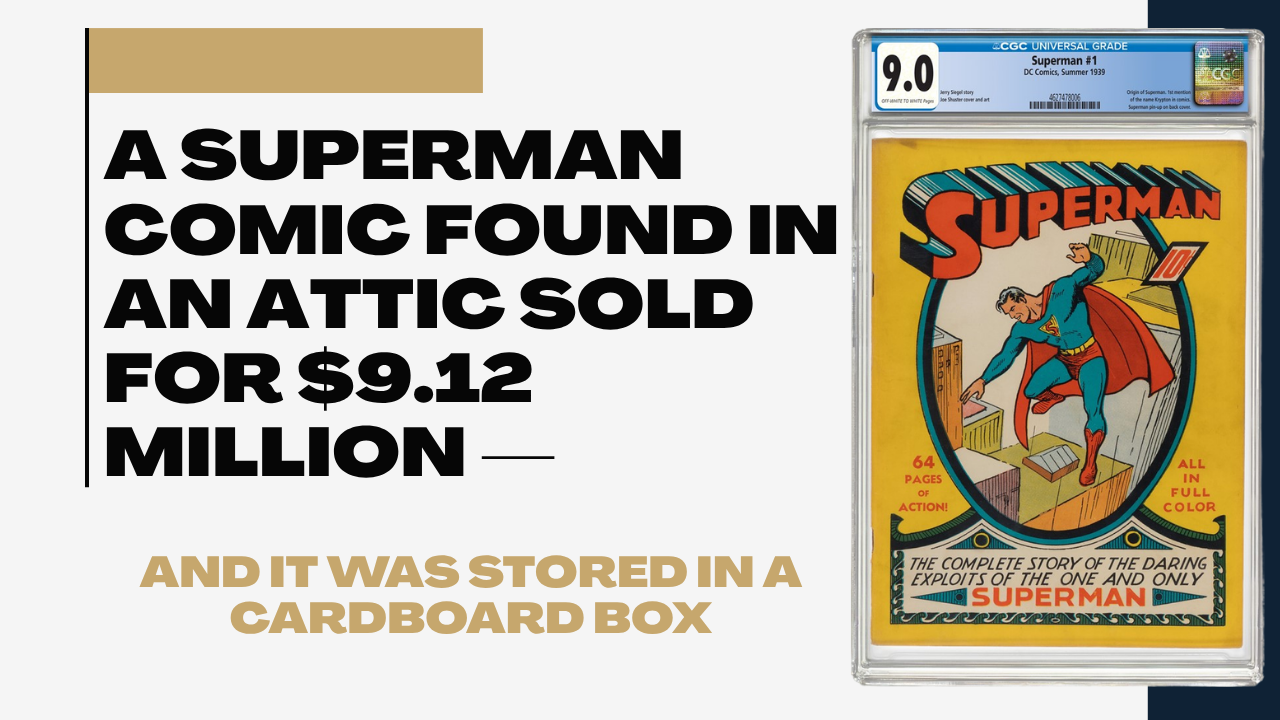
A Superman Comic Found in an Attic Just Sold for $9.12 Million — And It Was Stored in a Cardboard Box
Independent Insurance Broker · Former Moving Company Owner · Collectibles Enthusiast
The story reads like a movie script.
Three brothers in San Francisco are going through their late mother's attic. They knew she'd collected comic books — she'd always mentioned it — but they'd never been shown the collection. Tucked inside a cardboard box, protected by nothing more than a stack of yellowed newspapers, they find a copy of Superman No. 1.
Not just any copy. The copy.
When they submitted it to Certified Guaranty Company (CGC), the grading service assigned it a 9.0 — the highest grade ever recorded for the issue. On November 20, 2025, Heritage Auctions sold that comic for $9.12 million — the most expensive comic book ever sold at public auction, shattering the previous record by more than $3 million.
The irony is devastating: the most valuable comic in the world spent decades completely unprotected, in a box, under newspapers, uninsured. The margin between $9.12 million and $0 was a stack of newspapers.
2025: The Year Comics Rewrote Their Own Record Book
- Superman No. 1 (DC, 1939, CGC 9.0) — $9.12M at Heritage, Nov 20, 2025.
- Batman No. 1 (CGC 9.4) + Superman No. 1 (CGC 8.5, Mile High) — private sale of both: $6M and $7M, Feb 2026.
- Batman No. 1 (CGC 7.0) — $794,449 at Goldin Summer 2025.
- Frank Frazetta's 1967 Conan cover painting — $13.5M at Heritage, Sept 2025 (a new world record for fantasy art).
- Superman No. 1 (PSA 1.0) — $176,900 at Goldin Feb 2026. Even a damaged copy commanded six figures.
- Amazing Fantasy No. 15 (CGC 6.0) — $76,260 (first appearance of Spider-Man, mid-grade).
- Incredible Hulk No. 181 (CGC 9.8) — $54,900 (first Wolverine, Gem Mint).
Heritage Auctions' Comics & Comic Art category closed 2025 with $216.2 million in total auction sales.
Why Golden Age Comics Command These Prices
Historical significance. Superman No. 1 is the first standalone title for the character who created the superhero genre. Batman No. 1 introduced both the Joker and Catwoman. These are cultural artifacts.
Extreme scarcity at high grades. Of Superman No. 1, only 209 copies are recorded in CGC's Population Report — fewer than half in CGC's blue Universal label. The newly sold 9.0 is the only one ever graded that high.
CGC infrastructure. CGC revolutionized comic collecting the way PSA did sports cards. Numeric grades and tamper-evident encapsulation created a transparent, trusted marketplace.
Institutional buyers. The top end has attracted fine art collectors, hedge fund managers, and scarcity-driven investors — buyers who don't need to love Superman to recognize an irreplaceable asset.
The Comic Book Insurance Gap
The storage problem. Comics are paper. Vulnerable to water, humidity, UV, pests, and handling. A basement flood or burst pipe can destroy in minutes what took decades to build.
The condition-value relationship. A CGC 9.8 vs. a 9.6 of a modern key issue can be $5,000+. A 9.0 vs. 8.5 Superman No. 1 is millions. Even minor damage — not total loss — can be enormous financial harm.
The discovery problem. Many significant comics are still unaccounted for. Collectors who inherit may not realize what they have. Until professionally assessed, they can't be properly insured.
The pedigree premium. Mile High, Edgar Church, White Mountain — pedigreed copies trade at meaningful premiums. If your insurance treats it like a standard copy, you're underinsured.
Standard coverage is inadequate. A homeowners policy with a $2,500 collectibles sublimit is meaningless for any serious comic collection.
CGC Grading: The Foundation of Insurable Value
CGC grading creates authentication, objective condition documentation, registry, and market infrastructure. A CGC-slabbed comic is substantially easier to insure properly than an ungraded copy — the cert number links to a registry entry documenting grade, population, and any pedigree designation. The CGC scale: 10.0 (Gem Mint), 9.8 (Near Mint/Mint), 9.6 (Near Mint+), 9.4 (Near Mint), 9.0 (Very Fine/Near Mint), 8.0 (Very Fine), 6.0 (Fine), 4.0 (Very Good).
Key Issue vs. Reader Copy: The Distinction That Matters
Investment-grade key issues — first appearances and other "first" significance (Action Comics #1, Detective Comics #27, Amazing Fantasy #15, Hulk #1, X-Men #1). The MCU and DCEU directly drove demand for first appearances. These have the most robust comp records.
Reader copies and runs. Most comics have limited collectible value. A 5,000-book collection might have meaningful value concentrated in 20–50 key issues. Insurance strategy should focus on the keys — insuring by the box wastes premium money; identifying and individually scheduling the 30 books worth $1,000+ is the right approach.
What a Comic Insurance Program Should Include
Individual scheduling for all comics valued above $500. Agreed-value coverage. Coverage for condition damage, not just total loss. Storage location coverage (safe deposit, climate-controlled storage, vault). Annual appraisal review — the market moves quickly.
The Golden Age Is Not Behind Us
A Superman No. 1 in a cardboard box is now worth more than $9 million. A Batman No. 1 in excellent condition is worth $6 million. A first-appearance Spider-Man in middling condition is worth $76,000. These are price signals from a market with deep structural demand, genuine scarcity, and growing institutional participation.
The brothers who found their mother's Superman No. 1 were extraordinarily lucky. The comic survived. Don't rely on luck for your collection.
See how scheduled collectibles coverage works or have Cassondra walk through your collection.
The discovery problem
The Superman No. 1 attic story isn't a one-off. Significant comics are still sitting in attics, basements, and closets across the country — often inherited, often unrecognized.
- A box of comics from a grandparent — never sorted, never appraised.
- Issues from the 1960s and 70s stored in a non-climate-controlled garage.
- A 'reader copy' that's actually a key first appearance the owner didn't recognize.
- Collections insured by the box for $2,500 total — when 30 books in that box are worth $1,000+ each.
The first step isn't always insurance. It's a professional assessment of what you actually have. Until that happens, you can't properly value or protect it.
Practical Risk Management for Collectors
| Strategy | Why It Matters |
|---|---|
| Get key issues professionally graded by CGC | Authentication, condition documentation, and registry — the infrastructure that makes a comic insurable at its true value. |
| Individually schedule comics worth $500+ | Issue, publisher, year, CGC grade, cert, pedigree, current value supported by 2–3 comps. |
| Use agreed-value coverage | A Superman No. 1 CGC 9.0 cannot be 'replaced' — you need a fixed payout, not a substitute search. |
| Confirm coverage for condition damage, not just total loss | A 9.8 reduced to 9.4 by water can be a five-figure loss even though the book survives. |
| Document pedigree provenance | Mile High, Edgar Church, White Mountain — pedigree premiums are real and material to insured value. |
| Confirm storage-location coverage | Safe deposit box, climate-controlled storage, professional vault — coverage must follow the item. |
| Annual appraisal reviews | Adaptations, record sales, and shifting collector tastes can move values significantly in 12 months. |
Frequently Asked Questions
What is the most expensive comic book ever sold?
Superman No. 1 (DC, 1939) graded CGC 9.0 sold for $9.12 million at Heritage Auctions on November 20, 2025 — the highest price ever paid for a comic book at public auction. The copy was found in a California family's attic after decades of storage in a cardboard box under newspapers.
How do I insure my comic book collection?
Have significant comics graded by CGC, obtain a written appraisal referencing recent comparable auction results, and purchase a specialty collectibles policy with agreed-value coverage for individually scheduled key issues. Review coverage annually as the comic market appreciates.
Does CGC grading affect insurance value?
Yes, significantly. A CGC grade creates a documented, authenticated, registerable asset with an objective condition assessment. Insurers can more easily establish and defend value for CGC-graded comics. Small grade differences can represent tens or hundreds of thousands of dollars.
What is a pedigree comic and why does it matter for insurance?
Pedigree comics come from documented, named collections with known provenance, such as the Mile High or Edgar Church collection. CGC designates pedigree status on the label, and pedigree copies typically command premiums above non-pedigreed copies of the same issue and grade. This premium should be reflected in insurance appraisals.
Have a Comic Collection That's Never Been Properly Assessed?
Whether you own sports cards, memorabilia, watches, art, or other high-value collectibles, proper insurance starts with understanding the real exposure.
We help clients evaluate coverage gaps, valuation concerns, homeowners policy limitations, collectibles scheduling, and risk-management strategies.
Talk with an independent broker about protecting what you have worked hard to build.

Written by Cassondra Sells
Independent Insurance Broker · Former Moving Company Owner · Collectibles Enthusiast. Serving Arvada and the Denver metro with transparent, honest advice.
Read about the agency →