Nikola Jokic Joins the Million-Dollar Card Club — And It Highlights a Bigger Risk Most Collectors Ignore
Independent Insurance Broker · Former Moving Company Owner · Collectibles Enthusiast
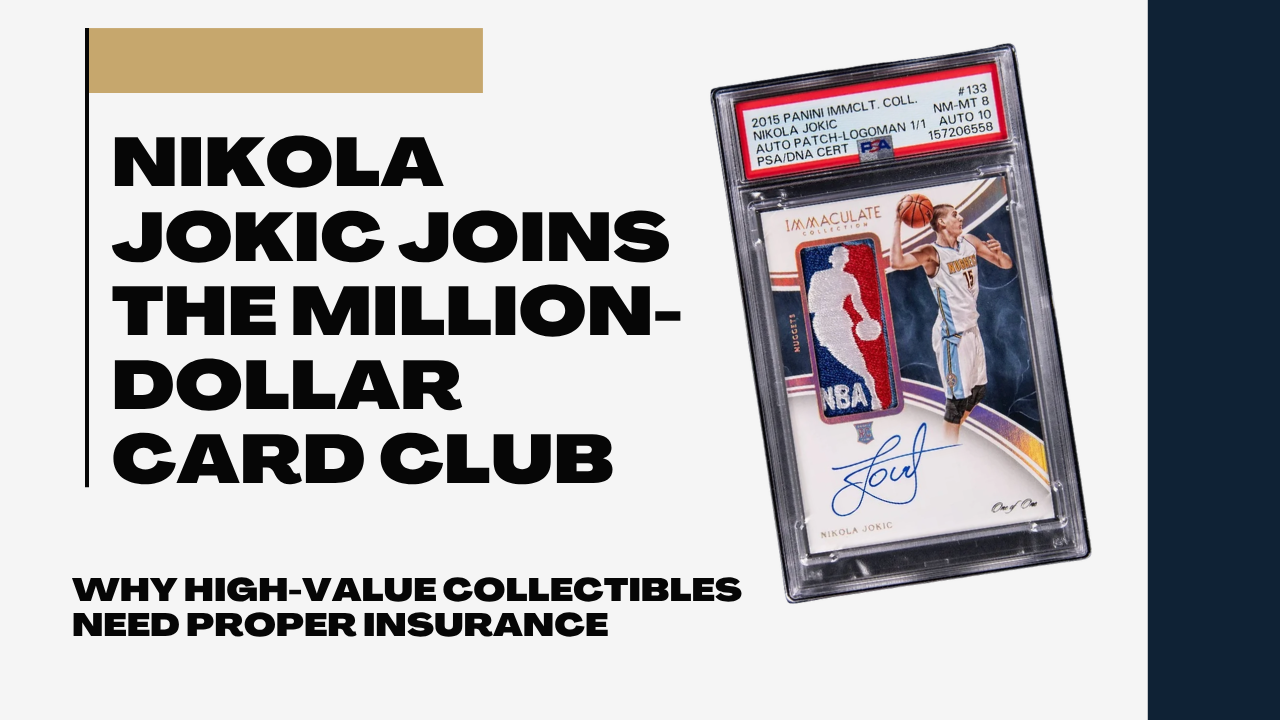
Nikola Jokic recently joined an elite group of athletes whose trading cards have sold for more than $1 million.
For sports fans and collectors, headlines like this are exciting.
But from an insurance and risk-management perspective, stories like this highlight something much bigger:
Most collectors are dramatically underinsured.
Over the last several years, sports cards, memorabilia, luxury collectibles, and alternative assets have exploded in value. What used to be considered a hobby collection sitting in a closet or safe is now, in many cases, a six-figure asset, an investment portfolio, inherited family property, business inventory, or part of long-term wealth preservation.
And many collectors assume their homeowners insurance automatically covers everything.
That assumption can become extremely expensive.
The Collectibles Market Has Fundamentally Changed
The collectibles industry has shifted dramatically over the past decade. What once lived in cardboard boxes in basements and attics now trades in auction houses, on dedicated marketplaces, and in private sales at prices that increasingly rival real estate. Sports cards, signed memorabilia, comic books, luxury watches, coins, wine collections, Pokémon cards, fine art, sneakers, vintage video games, rare documents, and celebrity memorabilia have all crossed into territory where individual items regularly sell for $50,000, $100,000, $500,000, or more than $1 million.
That shift has changed what these items are, financially. A 1986 Fleer Michael Jordan is no longer a piece of cardboard a kid kept in a shoebox. A graded modern rookie patch auto is no longer a hobby novelty. They are financial assets — sometimes appreciating faster than traditional investments — that sit inside homes designed to protect a TV and a couch, not a portfolio.
Nikola Jokic entering the million-dollar card category is another reminder that modern collectibles carry serious financial exposure. And as values rise, risk rises with them.
Why "My Homeowners Insurance Covers It" Is Usually Wrong
One of the biggest misconceptions collectors have is: "My homeowners insurance already covers my collection."
Sometimes partially. Rarely properly.
Most standard homeowners policies contain category sublimits for collectibles — often a few thousand dollars across an entire class like trading cards, coins, or memorabilia — alongside actual cash value limitations, documentation requirements, exclusions for "mysterious disappearance," and restrictions if the items are used in any way that touches business activity (selling, consigning, trading at shows). These provisions aren't buried fine print curiosities. They're the provisions that determine how much a collector actually receives after a loss.
A collection worth $150,000 may only have a fraction of that amount actually covered under a standard policy structure. And most collectors don't discover this until after something goes wrong — when the carrier explains that the trading-card sublimit is $2,500, or that a card classified as "business inventory" because it was being sold isn't covered at all.
The fix is usually some combination of scheduled personal property coverage, a dedicated collectibles policy, or an inland marine endorsement structured to the way the collection actually lives.
The Risks Go Way Beyond Someone Breaking In
Most people think collectibles insurance only matters if something gets stolen. Real-world losses are far more varied than that. Flooding, wildfire, accidental breakage, improper storage, moving damage, shipping loss, safe failures, humidity damage, burst pipes, smoke damage, and transit loss during grading or consignment all show up in claim files — frequently from collectors who never imagined the item would be lost to anything other than theft.
Colorado collectors in particular have learned this the hard way through hail, wildfire, and burst pipes after deep freezes. Even one event can permanently change a collection built over years or decades. And some of the most common causes of loss — humidity, water, accidental damage — are the ones collectors least expect.
Some Pieces Can't Be Replaced by a Check
Insurance cannot replace sentimental value. It cannot give back the card a collector inherited from a grandfather, the jersey signed in person at a game, or the comic discovered in a parent's attic the summer everything changed. Anyone who has spent years building a collection knows exactly which pieces those are.
But proper coverage can protect the financial side of a loss — and prevent a devastating outcome from becoming a catastrophic one. The goal isn't to make a loss painless. It's to make sure it doesn't compound.
The Logistics Problem Nobody Prepares For
From personal experience
Once collectibles reach extremely high values, the risks become much bigger than simply "keeping the card safe at home."
One of the biggest realities collectors face is that high-value collectibles create logistical risk.
In our own personal collection, we have owned an extremely high-value card — and the questions that immediately come up are very real:
- How do you safely transport it?
- How do you insure it while driving to an appraisal?
- What happens if you ship it?
- Is it covered while in transit?
- What if the package gets lost?
- What happens while it is being graded or authenticated?
- How is it insured on the way back?
- What if you travel to sell it in person?
- How do you safely meet a buyer?
- What if someone scams you?
- What if someone attempts to rob you?
These are not hypothetical concerns when an individual card can be worth tens of thousands of dollars, hundreds of thousands of dollars, or more than a home.
The logistics alone become a serious risk-management conversation.
Many collectors eventually realize that owning a high-value collectible starts to resemble transporting luxury jewelry, cash-equivalent assets, or fine art. That changes everything about storage, transportation, documentation, shipping, authentication, appraisal, security, and insurance structure.
For ultra-high-value collectibles, owners may need to think through armored shipping options, signature-confirmation procedures, private appointments, insured transit, secure meeting locations, appraisal documentation, chain-of-custody concerns — and personal safety.
Because once an item becomes publicly valuable, the exposure is no longer just financial. It can become a personal security issue as well.
Documentation Can Make or Break a Claim
When a major loss occurs, carriers typically ask for purchase records, grading documentation, photographs, appraisals, authentication certificates, inventory lists, and market valuation support. The collectors who organize that paperwork proactively are in a dramatically better position during a claim than those who are trying to reconstruct it afterward — often from memory, after the items themselves are gone.
The reality is that documentation gaps are one of the most common reasons collectibles claims settle below their actual value. A graded card without the slab or the grading record. A signed jersey without a COA. A wine bottle without a provenance trail. Each of those creates room for a carrier to value the loss conservatively — and to defend that valuation in writing.
Photographing every high-value item, keeping grading slips and purchase records in a secure location (including digital backup), and maintaining an updated inventory list are among the simplest and most impactful protective steps a collector can take — entirely independent of the insurance conversation.
Rising Values Create Hidden Insurance Gaps
An item purchased for $500 or $2,000 a few years ago may be worth dramatically more today. Many collectors never update their valuations, scheduled property endorsements, or appraisals — until after a loss reveals the gap. That moment — realizing the policy only covers a fraction of what was lost — is one of the most preventable and painful outcomes in this space.
Coverage that was adequate three years ago may not reflect today's market. Annual reviews of high-value collections are worth the effort, especially for categories (graded modern cards, watches, certain art segments) where values have moved aggressively in short windows.
Collectibles Are Increasingly Part of Serious Wealth Planning
High-net-worth individuals increasingly view collectibles as alternative investments, diversification assets, legacy property, and estate-planning assets. As the market matures, insurance and risk management become a natural part of the conversation — not an afterthought. Once collections move into six-figure or seven-figure territory, losses can be financially devastating in ways that affect estate value, tax planning, and generational wealth.
Practical Risk Management for Collectors
The good news is that many of the most important protective steps are straightforward — and don't require a comprehensive insurance overhaul to start.
| Risk Management Strategy | Why It Matters |
|---|---|
| Keep updated inventory records | Supports valuation during claims |
| Photograph every high-value item | Creates documentation proof |
| Store items properly | Reduces environmental and humidity damage |
| Use safes or secure storage | Reduces theft exposure |
| Update appraisals regularly | Helps avoid undervaluation as markets change |
| Review homeowners policy limits and sublimits | Identifies hidden coverage gaps before a loss |
| Consider specialized collectibles coverage | Provides broader protection than standard policies |
| Document grading and authentication records | Supports claim legitimacy |
| Review transit and shipping exposure | Critical for grading submissions, shows, and consignment |
| Work with experienced advisors | High-value collections require specialized guidance |
Insurance Should Match the Reality of the Asset
A million-dollar sports card is no longer "just a collectible."
And even collections worth far less can still represent years of investment, emotional attachment, financial planning, family legacy, and business exposure.
As collectibles continue appreciating in value, more owners are realizing they need insurance strategies that reflect the actual value and risk involved.
Because protecting assets is not just about homes, vehicles, and businesses anymore.
For many people, collectibles have become a serious part of personal wealth.
Frequently Asked Questions — Collectibles Insurance
Does homeowners insurance cover sports cards?
Sometimes, but rarely at the value collectors expect. Most standard homeowners policies include collectibles under personal property with low sublimits — often a few thousand dollars total for the entire category. A single high-value card can exceed that sublimit by orders of magnitude, which is exactly why specialized collectibles coverage or a scheduled personal property endorsement matters for serious collectors.
What types of collectibles can be insured?
Almost any high-value collectible: sports cards, signed memorabilia, comic books, luxury watches, coins, wine, Pokémon cards, art, sneakers, vintage video games, rare documents, and celebrity memorabilia. The right coverage structure depends on category, value, storage, and how often items move (shipping for grading, in-person sales, shows). An independent broker can match coverage to how the collection actually lives.
Why do collectibles need appraisals for insurance purposes?
Because the carrier needs a defensible valuation when paying a claim. An appraisal — or for graded items, the slab and grading documentation — establishes what the item was worth at the time of loss. Without that paper trail, even a legitimate claim can stall or settle far below market value. Appraisals also help collectors keep coverage current as markets shift.
Can collectibles be insured while shipping or traveling?
Yes, but the structure matters. Standard homeowners coverage often excludes or limits items in transit, while specialized collectibles policies and inland marine endorsements can extend protection during shipping, grading submissions, consignment, and travel. Collectors who regularly ship to PSA, BGS, or auction houses should specifically confirm transit coverage rather than assume it.
What happens if a collectible increases in value after I buy a policy?
Unless coverage is updated, the gap between current market value and insured value falls on the owner. Many collectors never revisit scheduled values after the initial purchase — and discover the shortfall only after a loss. Annual reviews of high-value collections, with updated appraisals where appropriate, are one of the simplest and most impactful protective steps a collector can take.
Have Questions About Protecting Valuable Collections?
Whether you own sports cards, memorabilia, watches, art, or other high-value collectibles, proper insurance starts with understanding the real exposure.
We help clients evaluate coverage gaps, valuation concerns, homeowners policy limitations, collectibles scheduling, and risk-management strategies.
Talk with an independent broker about protecting what you have worked hard to build.
Let's Talk About Your CollectionWritten by Cassondra Sells
Independent Insurance Broker · Former Moving Company Owner · Collectibles Enthusiast. Serving Arvada and the Denver metro with transparent, honest advice.
Read about the agency →Related reading
More on high-value asset protection
Why Standard Homeowners Insurance May Not Be Enough for High-Value Assets
Read more →
CollectiblesScheduled Personal Property Coverage: What It Is and When You Need It
Read more →
Home InsuranceColorado Wildfire Risk and What It Means for Homeowners
Read more →
Home InsuranceHigh-Value Homeowners Insurance: What Changes When Assets Grow
Read more →