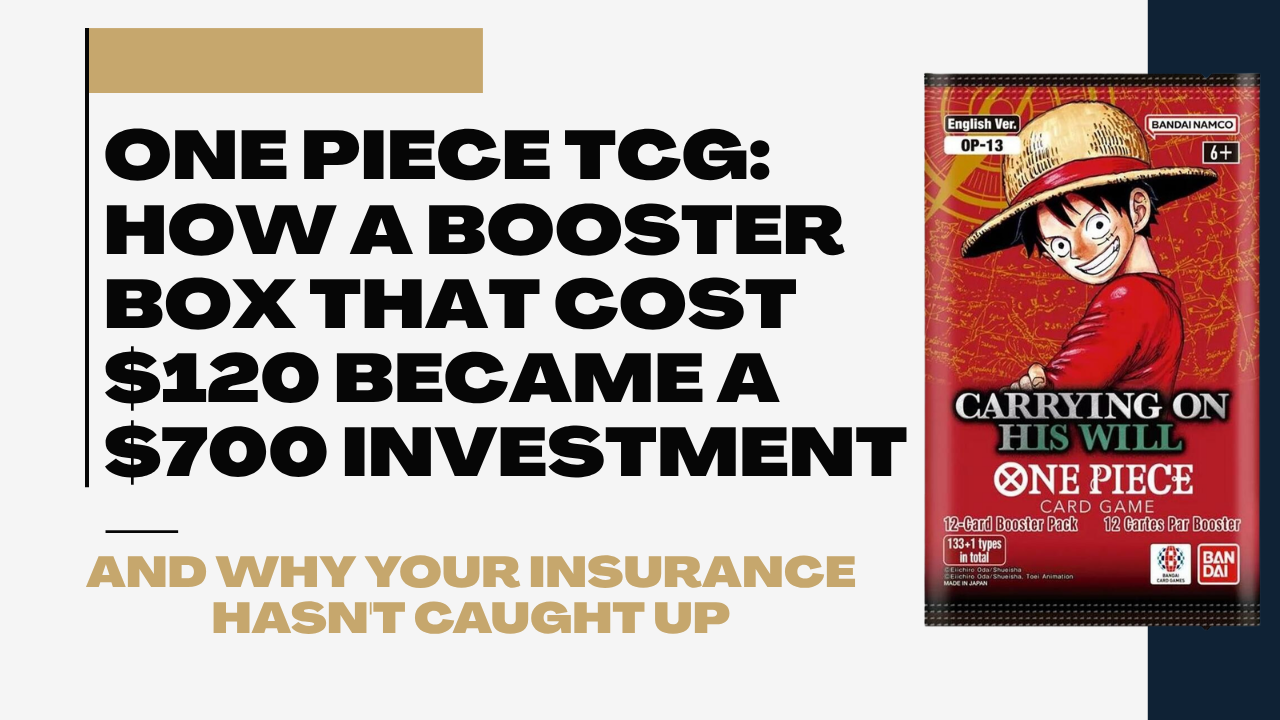
One Piece TCG: How a Booster Box That Cost $120 Became a $700 Investment — and Why Your Insurance Hasn't Caught Up
Independent Insurance Broker · Former Moving Company Owner · Collectibles Enthusiast
If you walked into a hobby shop in late 2024 and bought a booster box of One Piece TCG's OP-13 "Carrying On His Will" at MSRP, you paid around $120.
By the end of 2025, that same box was trading on eBay for $670–$750. On TCGPlayer, the market price sat at $702.87.
That's a roughly 490% return on a cardboard box in under twelve months — not on a stock, not on a cryptocurrency, not on real estate. On a trading card game product.
One Piece TCG has emerged as one of the most remarkable stories in the modern collectibles market. Launched in 2022 and dismissed by many as a fad chasing Pokémon's coattails, it has quietly become the third-highest-selling TCG in the world by sales volume — behind only Magic: The Gathering and Pokémon, ahead of Yu-Gi-Oh! for two consecutive months in late 2025.
And almost nobody who owns significant One Piece product has appropriate insurance coverage for it.
How One Piece Became a Serious Collectibles Market
The game features manga alternate art cards using panel art directly from Eiichiro Oda's original work — raw, expressive line art that resonates with long-time fans. The rarest "Super Alternate Art" versions are among the most visually distinctive cards in any TCG.
God Packs / Demon Packs — ultra-rare sealed packs containing only rare-or-higher cards, roughly 1 per 10–20 cases of OP-13 — make sealed product lottery-like.
Tournament promo exclusives distributed only as prizes at organized play events are printed in extremely limited quantities and trade at four figures.
The OP-13 Surge: A Case Study
OP-13 released November 7, 2025. The price trajectory of booster boxes:
- MSRP at release: ~$120
- Nov 30 (23 days in): $231 — up 47%
- Mid-December: $250
- Dec 31: $280+
- Year-end eBay: $670–$750
- TCGPlayer market: $702.87
Individual chase cards went even further: Monkey D. Luffy OP13-118 Red Manga Super Alternate Art at ~$8,950 raw, Sabo OP13-120 at $5,000+, Ace OP13-119 at $4,200+. The total OP-13 set value on Limitless TCG reached $30,253 by year-end across 175 cards.
The Sealed Product Dimension
Sealed One Piece product is its own category of insurable value. A sealed 1996 Japanese Pokémon Base Set Booster is worth tens of thousands precisely because nobody opened it. The same dynamic is forming around sealed One Piece product from early sets.
Sealed is harder to insure properly than graded singles because there's no third-party authentication number, condition grading is different (pack fresh vs. shelf wear), and values are more volatile (changes with the secondary market for the contents).
For insurance: authenticate seal and condition (BBCE for sports cards has equivalents for TCGs), photograph all six sides, value on 90-day trailing comparable sales rather than spot prices, and reappraise quarterly for active sets.
Why One Piece Is Especially Hard to Insure
Market youth. Three years of data. No decade-long price history. Requires appraisers with specific TCG market expertise.
Japanese vs. English divergence. Cards from different regions are printed in different quantities and trade at different premiums.
Print run opacity. Unlike sports cards with serial numbers, One Piece doesn't publish print run data. Pull rates are estimated from community data.
Competitive play dynamic. Card values spike when a card becomes "meta" and drop when new cards make it obsolete. Meta-driven appraisals can be overstated within months.
Building an Insurance Strategy
Under $500: Photographic documentation, keep receipts. Individual scheduling isn't cost-effective.
$500–$5,000: Individual scheduling. Use recent eBay completed listings and TCGPlayer market data. Update values quarterly.
$5,000+: Professional appraisal, specialty collectibles policy, agreed-value coverage, annual minimum reappraisal.
For sealed product specifically: get BBCE or equivalent authentication, document seal condition, use a 90-day trailing average for valuation, and consider vault storage with confirmed policy coverage at the storage location. Get $1,000+ singles graded — the cost is justified by insurance and resale benefits.
The Bigger Picture
One Piece TCG is simultaneously a playable game, a collector's market, and an investment vehicle. The same card might be sought by a competitive player, a manga collector, and a financial investor — each bringing different price sensitivity. This multi-demand structure is actually stabilizing at the top of the market.
The sealed product market carries more volatility but also more upside — and it's where the most dramatic insurance gaps currently exist. The market is three years old and already producing five-figure singles, four-figure tournament promos, and six-fold returns on sealed product in a year. The question isn't whether it deserves serious insurance treatment. It's whether you've updated your policy to reflect a market that has moved faster than most collectors anticipated.
Explore scheduled collectibles coverage or have Cassondra review your TCG holdings.
The conversation collectors aren't having
Most collectors I talk with about One Piece have the same realization mid-conversation: they spent $2,400 on a case of OP-13 at MSRP, it's now worth $10,000–$20,000 sealed, and their homeowners policy categorizes it the same as a TV.
- Did you reappraise after OP-13 surged 490%?
- Is your sealed product authenticated and individually scheduled?
- What's your transit coverage if you ship a case to consignment?
- Have you accounted for the Japanese vs. English print difference?
- Does your policy follow the cards to tournaments and grading drop-offs?
None of these questions are exotic. They're just the ones that surface only after a loss — when the answer matters most.
Practical Risk Management for Collectors
| Strategy | Why It Matters |
|---|---|
| Tier your collection by value | Under $500: document and keep receipts. $500–$5K: schedule individually, quarterly value updates. $5K+: specialty policy, agreed-value, annual reappraisal. |
| Authenticate sealed product (BBCE or equivalent) | Seal integrity and box condition are the foundation of sealed valuations. |
| Use 90-day trailing averages for sealed | Spot prices distort with single auctions. A trailing average is a more defensible insured value. |
| Reference the correct language market | Japanese and English prints trade at different premiums — your appraiser must use the right comp set. |
| Grade $1,000+ singles | PSA or CGC grading authenticates the card and creates a registerable asset that's much easier to insure. |
| Quarterly reappraisal for active sets | Meta shifts and god-pack pull data move values fast — annual cycles miss real exposure. |
Frequently Asked Questions
How much are One Piece TCG booster boxes worth?
One Piece TCG OP-13 booster boxes surged from a $120 MSRP to $670–$750 on eBay and $702 on TCGPlayer by end of 2025 — a roughly 490% increase. Older sets like OP-01 appreciated approximately 299% year-over-year during the same period.
What is the most valuable One Piece TCG card?
The Monkey D. Luffy OP13-118 Red Manga Super Alternate Art is among the most valuable, with raw values of approximately $8,950. The Sabo OP13-120 Super Alternate Art and Ace OP13-119 have also traded above $4,000–$5,000 raw.
How do I insure sealed One Piece TCG booster boxes?
Sealed TCG product requires authentication documenting seal integrity and box condition, high-resolution photography of all sides, and valuation based on recent comparable completed sales on eBay and TCGPlayer. A specialty collectibles insurer can schedule sealed product as individual items with agreed-value coverage.
Holding Significant One Piece TCG Inventory?
Whether you own sports cards, memorabilia, watches, art, or other high-value collectibles, proper insurance starts with understanding the real exposure.
We help clients evaluate coverage gaps, valuation concerns, homeowners policy limitations, collectibles scheduling, and risk-management strategies.
Talk with an independent broker about protecting what you have worked hard to build.
Written by Cassondra Sells
Independent Insurance Broker · Former Moving Company Owner · Collectibles Enthusiast. Serving Arvada and the Denver metro with transparent, honest advice.
Read about the agency →