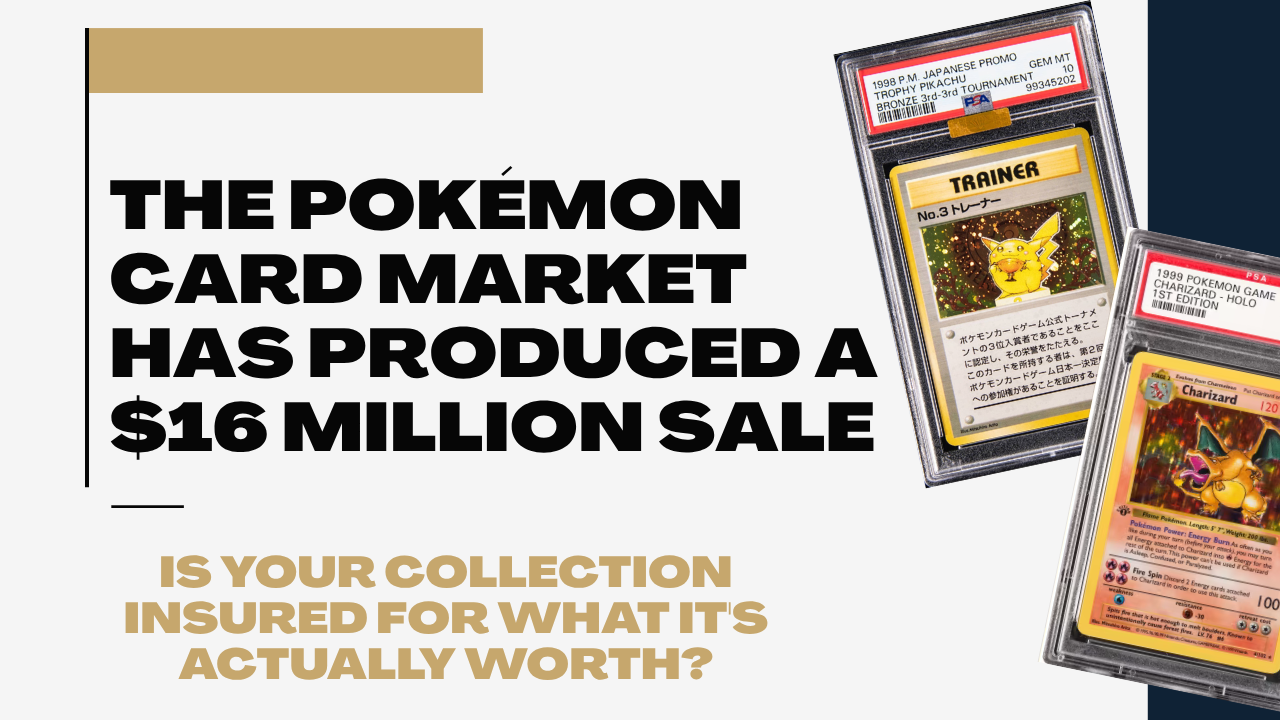
The Pokémon Card Market Has Produced a $16 Million Sale — Is Your Collection Insured for What It's Actually Worth?
Independent Insurance Broker · Former Moving Company Owner · Collectibles Enthusiast
In February 2026, Logan Paul's PSA 10 Pikachu Illustrator card sold at Goldin Auctions for $16.492 million — the most expensive trading card ever sold at auction, in any category.
Let that settle for a moment. A Pokémon card. Worth more than $16 million.
If you've been in the Pokémon hobby for any length of time — whether you collected as a kid, got back in during the pandemic, or picked it up recently — you already know the market has changed fundamentally. What's less obvious is how dramatically the floor has risen alongside the ceiling, and what that means for collectors who still think of their cards as a fun hobby rather than a serious financial asset.
The Pikachu Illustrator: Why It Cost $16M
The Pikachu Illustrator isn't a game card. It was a prize awarded to winners of the CoroCoro Comic Illustration Contest in Japan in 1997 and 1998. Fewer than 40 copies are believed to exist worldwide. No official count has ever been confirmed by The Pokémon Company.
Logan Paul purchased his copy in 2022 for $5.275 million — already a world record at the time. He had it mounted in a custom diamond-encrusted gold necklace, wore it to WrestleMania 38, and put it back up for auction in early 2026 with estimates of $7–12 million. It sold for $16.492 million.
The sale establishes that ultra-rare Pokémon cards operate in the same financial category as blue-chip art. That provenance adds premium. And that PSA 10 grades at extreme rarity levels are market-defining — Paul's copy is the only Pikachu Illustrator ever graded PSA 10.
The Rest of the Market Is More Robust Than You Think
The Pikachu Illustrator is the outlier. The market beneath it is far more substantial than casual observers realize.
- 1998 Japanese Promo Bronze 3rd Place Trophy Pikachu (PSA 10) — the only PSA 10 in existence; bidding in Goldin's Spring 2026 sale crossed $65,000 with weeks remaining, expected to surpass the prior $216,000 record.
- 1st Edition Shadowless Charizard (PSA 10) — sold for $550,000 at Heritage Auctions in late 2025.
- 1996 Japanese Base Set Charizard — continues to anchor the high end of the vintage market.
- Modern Illustration Rares — particularly from the Prismatic Evolutions set — trading at significant multiples of retail.
Spending on non-sports trading cards including Pokémon jumped 350% between 2020 and 2025. eBay users searched for "Pokémon" nearly 14,000 times per hour in 2024.
The Three Tiers of the Market
Tier 1 — Trophy and Contest Prizes. Pikachu Illustrators, Trophy Pikachus, Kangaskhan Parent-Child. Populations under 40. Value driven by historical significance, absolute scarcity, and grade. Bespoke agreed-value coverage with specialist appraisal documentation.
Tier 2 — High-Grade Vintage Icons. PSA 10 1st Edition Shadowless Base Set, Japanese Base Set in top grades. Tens of thousands to several hundred thousand dollars. Where most serious collectors have meaningful exposure.
Tier 3 — Modern Chase Cards. Special Illustration Rares, alt arts, gold/rainbow versions from current sets. Spike dramatically, also carry more volatility. Requires more frequent reappraisal — quarterly or even monthly for significant pieces.
Why Pokémon Is Hard to Insure Properly
The population problem. A PSA 10 1st Edition Shadowless Charizard is dramatically more valuable than a PSA 9, but they look nearly identical. The slab and registry are what distinguish them financially.
Reprint risk. Unlike sports cards, Pokémon continues to produce new product. Reprint announcements can affect modern card values quickly.
International dynamics. Japanese vs. English versions trade at different premiums depending on the card. Appraisal needs to reference the correct comparable market.
Authentication complexity. Sophisticated fakes exist, particularly for vintage Base Set. Any significant ungraded vintage card should be graded before being insured.
Sealed product. A sealed 1996 Japanese Base Set Booster is worth tens of thousands. Sealed requires different appraisal methodology and may need separate policy treatment.
What a Pokémon Insurance Program Should Include
- Individual scheduling for any card worth more than $1,000, with slab number, registry entry, and current appraisal.
- Agreed value, not actual cash value. You want the full agreed amount, not an adjuster's post-loss negotiation.
- Coverage for the slab itself. A cracked case that requires reholdering has real cost.
- Sealed product as a separate line with its own appraisal methodology.
- New-acquisition coverage — automatic 30–60 days for new buys.
- Worldwide coverage for shows, tournaments, and grading drop-offs.
Documentation Infrastructure
For a Pokémon collection to be properly insured, you need a documentation stack: the physical slab, PSA/BGS registry printout, purchase documentation, 2–3 comparable sales records, signed appraiser's letter, and high-resolution photos. This stack is what turns a collection into an insurable asset.
Why Values Are Structural, Not Speculative
A common assumption is that Pokémon is a bubble. The structural forces tell a different story: absolute scarcity of true rarities (~39 Pikachu Illustrators in existence, a number that can only shrink), the cultural permanence of the IP (the highest-grossing media franchise in history), and the maturation of authentication infrastructure (PSA, BGS, CGC, Card Ladder pricing, Goldin/Heritage/PWCC auctions).
The ceiling, as established in February 2026, is $16.492 million. The floor is wherever the Charizard market settles this year. And somewhere in between is your collection, waiting to be properly valued and protected.
See how scheduled collectibles coverage works or talk with Cassondra about a Pokémon-specific review.
What I see across Pokémon collectors
The most common conversation I have with Pokémon collectors goes like this: "I have a Charizard." Great. "It's a 1st Edition Shadowless." Beautiful. "What's my homeowners policy do for it?" — and then the silence when we look up the collectibles sublimit.
- A PSA 9 1st Edition Shadowless Charizard rediscovered from childhood — $60K–$80K exposure on a $2,500 sublimit.
- A modern Special Illustration Rare collection that doubled in value between annual reviews.
- A Trophy Pikachu Bronze in PSA 7 acquired privately — no recent public comp, no documented appraisal, no scheduled coverage.
- Sealed Japanese Base Set booster product treated like regular personal property on the homeowners side.
None of these collectors did anything wrong. They just discovered, too late, that "covered" and "covered for what it's actually worth" are two very different things.
Practical Risk Management for Collectors
| Strategy | Why It Matters |
|---|---|
| Individually schedule any card worth $1,000+ | Standard homeowners sublimits won't touch the value of modern chase cards or vintage icons. |
| Use PSA, BGS, or CGC slabs | The cert number links to a registry entry — without it, a $550K card is indistinguishable from a $50K one. |
| Reappraise modern chase cards quarterly | Set-driven volatility means annual reviews aren't enough for the modern tier. |
| Treat sealed product as its own line | Sealed booster boxes and packs use different valuation methodology than graded singles. |
| Confirm worldwide and submission coverage | Shows, tournaments, and grading drop-offs are all off-premises exposure. |
| Document private buys at acquisition | Trophy-tier cards rarely have public comps — appraisal must be built proactively, not after a loss. |
Frequently Asked Questions
How much is the most expensive Pokémon card ever sold?
Logan Paul's PSA 10 Pikachu Illustrator sold for $16.492 million at Goldin Auctions in February 2026, making it the most expensive trading card ever sold at auction in any category.
How do I insure my Pokémon card collection?
Get high-value cards graded by PSA or BGS, obtain a written appraisal with comparable sales documentation, and purchase a specialty collectibles policy with agreed-value, scheduled-item coverage. Standard homeowner's insurance is typically insufficient for any significant Pokémon collection.
How much is a 1st Edition Shadowless Charizard worth?
A PSA 10 1st Edition Shadowless Charizard sold for $550,000 at Heritage Auctions in late 2025. Lower grades command significantly less — a PSA 9 example typically trades between $30,000 and $80,000 depending on market conditions.
Does homeowner's insurance cover Pokémon cards?
Standard homeowner's or renter's insurance typically covers collectibles with a sublimit of $1,000–$2,500 — far below the value of any serious Pokémon collection. Specialty collectibles insurance with individual scheduled items is required for proper protection.
Have a Pokémon Collection You're Not Sure Is Covered?
Whether you own sports cards, memorabilia, watches, art, or other high-value collectibles, proper insurance starts with understanding the real exposure.
We help clients evaluate coverage gaps, valuation concerns, homeowners policy limitations, collectibles scheduling, and risk-management strategies.
Talk with an independent broker about protecting what you have worked hard to build.

Written by Cassondra Sells
Independent Insurance Broker · Former Moving Company Owner · Collectibles Enthusiast. Serving Arvada and the Denver metro with transparent, honest advice.
Read about the agency →