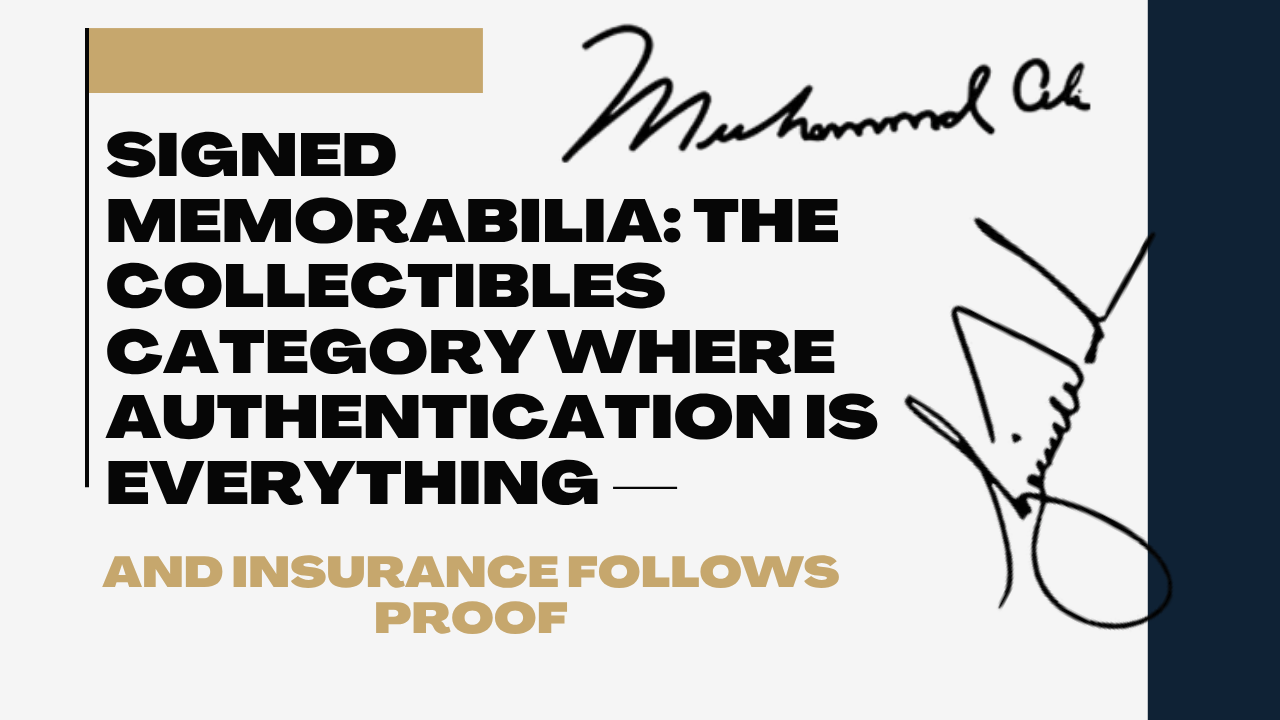
Signed Memorabilia: The Collectibles Category Where Authentication Is Everything — and Insurance Follows Proof
Independent Insurance Broker · Former Moving Company Owner · Collectibles Enthusiast
There's an auction lot that tells you everything about the signed memorabilia market in one line: "The Beatles: Incredible Group Signed 'With the Beatles' Album Cover — One of the Finest Beatles Signed Albums Extant!"
That album cover, offered through Iconic Auctions in May 2025 alongside 1,400+ other lots, carries two authentication letters of opinion — from JSA and Epperson/REAL. It isn't just authenticated once. It's authenticated twice, by two of the most respected names in the business, because the stakes are high enough to warrant double verification.
That's the signed memorabilia market in a sentence: extraordinary items, serious money, and authentication as the linchpin of everything.
Unlike sports cards (PSA, BGS, SGC grading scales) or comics (CGC numeric benchmarks), signed memorabilia presents a more complex valuation challenge. Every autographed item is unique — different signers, formats, conditions, provenance chains — and the difference between authenticated and unauthenticated can be the difference between $500 and $500,000.
What the Market Looks Like Right Now
Sports autographs remain the largest segment — jerseys, balls, helmets, photographs, signed cards. At Pristine Auction, active lots include Luka Dončić and Shai Gilgeous-Alexander signed jerseys with PSA authentication.
Historical and cultural autographs have institutional buyers — universities, museums, libraries. University Archives' February 2026 sale realized nearly $1.2 million, headlined by a first edition Book of Mormon (1830) at $250,000.
Music memorabilia is among the most volatile — Hendrix guitars, handwritten Beatles lyrics, Dylan manuscripts. Value transcends hobby collecting into fine art territory.
Iconic Auctions' May 2025 sale illustrates breadth: a Bill Russell signed 1957 Topps Rookie Card (PSA/DNA GEM MINT 10 auto), a Jim Morrison signed bail bond document from his 1969 Miami arrest, a Thomas Edison 1881 light bulb patent application, a Benjamin Franklin signed land grant.
The Authentication Imperative
If there's one principle that defines this market above all: an unauthenticated signature is worth significantly less than an authenticated one, and an item with forged authentication is worth nothing — and potentially a legal liability.
The authentication ecosystem:
- JSA (James Spence Authentication) — one of the two dominant U.S. services. Issues LOAs, can encapsulate items. Strong across all categories.
- PSA/DNA — Pokémon parent PSA's autograph arm. Slabs carry significant market credibility.
- Beckett Authentication Services (BAS) — especially respected for sports.
- Epperson/REAL — Roger Epperson is the globally recognized music memorabilia expert; his LOA on Beatles items is among the most credible in the world.
- Phil Sears — Hollywood golden age and television specialist.
Why Signed Items Are Uniquely Hard to Insure
Every item is one-of-a-kind. A Jordan game-worn signed jersey with specific game attribution is the only one like it. Comps must be analyzed with judgment, not precision.
The signer's status changes. A championship, Hall of Fame induction, or passing changes the value of a signature. Insurance from five years ago may be significantly wrong today.
Condition and format dramatically affect value. Signature on clean jersey panel vs. worn area. Bold vs. faded. Full "Muhammad Ali" vs. "Ali." Insurance appraisals must reflect these differentials.
Proximity to the signer matters. Direct from a signing event vs. through a dealer chain. Photographic documentation of the actual signing creates real provenance premium.
High-Value Examples by Category
- Presidential / Historical: George Washington document — $9.8M (world record for any autograph). Lincoln letter — $100K–$500K+. Einstein letter — $50K–$200K.
- Sports: Babe Ruth signed baseball — $15K–$100K+. Muhammad Ali championship belt — $25K–$75K. Jordan game-worn signed jersey — $50K–$200K.
- Music: Beatles fully group-signed album — $50K–$300K+. Hendrix signed guitar — $100K–$300K+. Elvis signed photograph — $5K–$30K.
- Entertainment: Full-cast signed movie poster — $5K–$75K+. Early Disney art signed by Walt Disney — $25K–$100K+.
The Forgery Problem
The signed memorabilia market has a forgery problem more serious than sports cards or comics. Several factors make it endemic:
High-volume signers. Athletes who signed thousands of items leave a large baseline that's easy to flood with fakes.
Deceased signers cannot confirm. Authentication relies entirely on comparative analysis and provenance — no recourse to the source.
Fraudulent authentication services. Some have been operated by forgers themselves. An LOA from a discredited service may be worse than no authentication at all.
Insurance implication: An item insured based on fraudulent authentication may trigger a coverage dispute at claim time. Insurers may require verification of authentication credentials as part of underwriting — and should. Items authenticated only by lesser-known services should get a second opinion from JSA, PSA/DNA, or Beckett.
Building an Insurance Program for Memorabilia
Documentation requirements: authentication letter(s) from recognized services (dual for high-value), provenance documentation, high-resolution photos, current market appraisal within 12–18 months, condition assessment beyond just the signature.
Policy features: agreed-value coverage with no depreciation. No "sentimental value" exclusion (for memorabilia, narrative and provenance are part of market value). Coverage for authenticity disputes where available. Worldwide coverage for items that travel to shows, auctions, or private viewings.
When to Re-Review Coverage
Trigger an immediate review when: the signer passes away (values typically spike), wins a major award or HOF induction, a comparable sells for significantly more than your insured value, new forgeries are identified in your category, or an authentication service issues a policy update.
Modern Categories Worth Knowing
Signed trading cards — Bill Russell signed 1957 Topps Rookie (Gem Mint 10 auto) is a convergence of cards and memorabilia, worth more than either alone.
Signed Funko Pops with PSA authentication — Johnny Depp as Jack Sparrow is a real insurable asset.
Signed game-worn equipment — MeiGray Group authenticates game-worn pro sports equipment. A signed AND game-used jersey requires documentation of both.
The Bottom Line
Signed memorabilia is among the most emotionally resonant collectibles — these items carry the literal mark of human beings who shaped history, sports, and culture. That emotional dimension is part of their value. It's also part of what makes them vulnerable: collectors form attachments that can cloud judgment about insurance.
An improperly authenticated item is worth a fraction of an authenticated one. An uninsured item is worth nothing if destroyed. An item insured at five-year-old values may be dramatically underinsured today.
Authentication, documentation, and proper specialty coverage aren't obstacles to enjoying your collection. They're what allow you to hold it with confidence.
See how memorabilia coverage works or have Cassondra walk through your collection.
Why memorabilia is uniquely complex
Sports cards have grading scales. Comics have CGC. Memorabilia has a more complex problem: every item is one-of-a-kind, the signer's status changes, and the line between authenticated and unauthenticated can be the line between $500 and $500,000.
- A signed jersey: depends on the signer, the condition of both signature and jersey, the format, and the signing provenance.
- A Beatles album: dual authentication (JSA + Epperson/REAL) becomes standard for top items because the stakes warrant double verification.
- A presidential autograph: provenance back to the signer is the foundation of value.
- A game-used signed jersey: requires authentication of both the autograph AND the game use (MeiGray Group for pro sports equipment).
For memorabilia more than any other category, the insurance conversation begins with the authentication conversation.
Practical Risk Management for Collectors
| Strategy | Why It Matters |
|---|---|
| Authentication letter(s) from recognized services | JSA, PSA/DNA, Beckett, Epperson/REAL — for high-value items, dual authentication is worth the cost. |
| Provenance documentation | Chain of custody back to the signer — photos of the signing event, dealer receipts, auction records. |
| High-resolution photographs | Front, back, signature detail, inscription, condition issues — establishes baseline for claims. |
| Current market appraisal (within 12–18 months) | Signer status changes (championships, induction, passing) move value quickly. |
| Agreed-value coverage with no 'sentimental value' exclusion | Provenance and narrative are part of market value — policies that exclude this leave gaps. |
| Worldwide coverage | Items travel to shows, auctions, private viewings, on loan — coverage should follow. |
| Re-authenticate if a forgery ring surfaces in your category | Authentication services occasionally revise opinions; monitor and act on category-specific alerts. |
Frequently Asked Questions
What authentication services are accepted by insurance companies for memorabilia?
The most widely recognized authentication services for signed memorabilia are JSA (James Spence Authentication), PSA/DNA, Beckett Authentication Services (BAS), and Roger Epperson/REAL for music items. Items authenticated by these services are more readily accepted by specialty insurers and easier to defend in claims.
Why is dual authentication recommended for high-value memorabilia?
Dual authentication — by two independent recognized services — provides the strongest market and insurance defense for high-value signed items. It removes single-source authentication risk and reflects the consensus opinion of multiple experts.
Can sentimental value be insured?
Sentimental value itself typically can't be insured, but the market value of a signed item — which often incorporates emotional and provenance factors — can be. Specialty collectibles policies pay agreed value based on documented market estimates, including any provenance premium.
How do I insure a signed jersey or game-used equipment?
Obtain authentication of the signature (JSA, PSA/DNA, BAS) and, if applicable, authentication of the game use (MeiGray Group for NHL/NBA equipment). Get a written appraisal from a qualified appraiser, and schedule the item individually on a specialty collectibles policy with agreed-value coverage.
Have Signed Memorabilia That Needs Proper Authentication & Coverage?
Whether you own sports cards, memorabilia, watches, art, or other high-value collectibles, proper insurance starts with understanding the real exposure.
We help clients evaluate coverage gaps, valuation concerns, homeowners policy limitations, collectibles scheduling, and risk-management strategies.
Talk with an independent broker about protecting what you have worked hard to build.
Written by Cassondra Sells
Independent Insurance Broker · Former Moving Company Owner · Collectibles Enthusiast. Serving Arvada and the Denver metro with transparent, honest advice.
Read about the agency →