The Sports Card Market Is Rewriting Record Books — And Your Insurance Policy May Not Know It
Independent Insurance Broker · Former Moving Company Owner · Collectibles Enthusiast
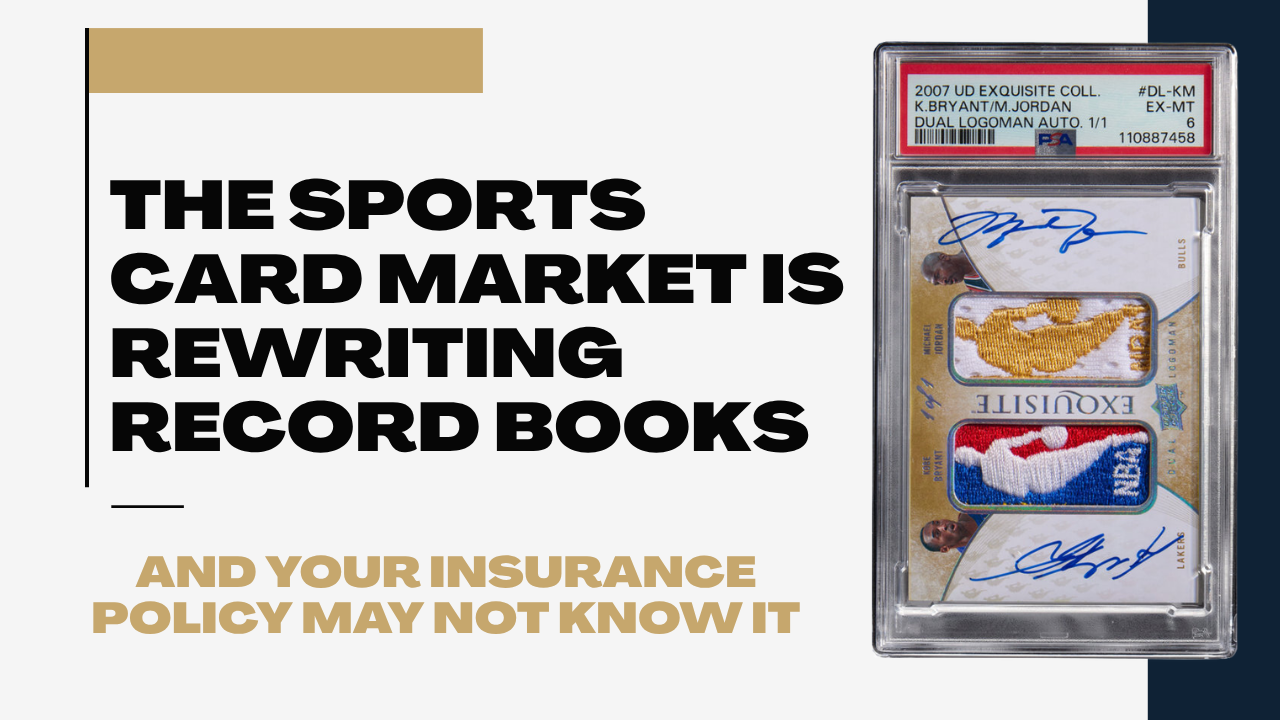
There's a card sitting in a collector's vault right now worth more than most people's homes, cars, and retirement accounts combined. It's a small rectangle of cardboard — a 2007–08 Upper Deck Exquisite Michael Jordan and Kobe Bryant dual autographed patch card, numbered 1/1. In August 2025, it sold at Heritage Auctions for $12.93 million, setting the all-time record for the most expensive sports card ever sold at public auction.
That number would have been unthinkable a decade ago. Today, it's just the headline.
The sports card market has undergone one of the most dramatic transformations in the history of alternative assets. Cards that once lived in shoeboxes are now stored in climate-controlled vaults, traded on platforms that rival stock exchanges, and insured — when collectors are smart enough to do it — for seven and eight-figure sums. A large and growing number of collectors are sitting on serious wealth without the documentation, authentication, or insurance coverage to protect it.
What the 2025 Market Actually Looked Like
The headline $12.93M wasn't a fluke. It was the pinnacle of a year that produced over $100 million in high-end sales, driven by a consistent theme: icons never lose their magic when supply is truly irreplaceable.
- Jordan-Kobe Dual Logoman (2007–08 Upper Deck Exquisite, 1/1, PSA 6) — $12.93 million at Heritage Auctions.
- Jordan-LeBron Dual Logoman (2006–07 Upper Deck Exquisite, 1/1) — $10 million in a private sale.
- Luka Dončić Rookie Logoman (2018–19 Panini Flawless, 1/1) — $4.7 million in a private sale.
- 1914 Baltimore News Babe Ruth (SGC 3) — $4.03 million at Heritage.
- Shohei Ohtani 2025 Topps Chrome Gold Logoman (1/1) — $3 million.
- Paul Skenes Rookie Patch Auto (1/1) — $1.11 million.
- Caitlin Clark rookie card — $366,000, a record for any female athlete card.
For eBay — still the world's largest secondary market — the top sale of all of 2025 was a 1986–87 Fleer Michael Jordan PSA 10 at $260,000.
Why These Values Are Real, Not Speculative
Absolute scarcity. A true 1/1 Logoman cannot be replicated. It was made once, from game-worn material, with a live signature. That physical reality doesn't change regardless of market conditions.
Authentication infrastructure. PSA, BGS, and SGC have professionalized authentication to a degree that rivals fine art appraisal. A PSA 10 grade carries global credibility — and that's what allowed the market to scale from retail hobbyists to institutional-level buyers.
The flight to quality. The broader market did cool from its 2021 pandemic peak — average cards fell 30–50% — but the top tier moved in the opposite direction. PSA 10 icons, 1/1 Logomans, and historically significant vintage pieces kept appreciating. This mirrors what happens in art and jewelry markets when serious money concentrates in the rarest pieces.
Demographics. Collectors who grew up with Jordan, Mantle, and Ruth are now in their peak earning years. The nostalgia premium isn't fading — it's compounding.
The Auction Ecosystem Has Grown Up
Sports cards are no longer primarily traded at local shows or on eBay. A full auction industry now operates with the infrastructure of traditional fine art auctioneers.
Heritage Auctions is the largest, with 2025 results contributing to a record $2.158 billion total across all categories. Goldin focuses heavily on sports cards and pop culture with its quarterly "Goldin 100" elite auctions. PWCC operates more like a marketplace with high price transparency. REA (Robert Edward Auctions) dominates the vintage segment. Multiple auctions are running at any given moment.
The Insurance Gap Most Collectors Don't See
The uncomfortable truth: the majority of sports card collectors — even serious ones with five- and six-figure collections — are dramatically underinsured. Many have no specialty collectibles coverage at all.
Standard homeowners and renters policies have limitations that make them nearly useless for serious collectors:
- Sublimits on collectibles. Most standard policies cap "collectibles" or "memorabilia" at $1,000 to $2,500 total. A single PSA 10 Jordan rookie can exceed that by 100x.
- No scheduled coverage for individual items. Without a scheduled or floater policy listing specific items at appraised values, there's no guarantee a card is covered at true market value.
- No coverage for market appreciation. A card bought for $5,000 three years ago and worth $50,000 today is typically paid out at acquisition cost, not current value.
- Condition-based valuation disputes. Adjusters without collectibles expertise will dispute claims based on their own valuation, and without independent appraisal, you're fighting an information asymmetry battle.
- Private-sale opacity. A growing share of top transactions happen privately. Establishing value for an item with no public comp requires proactive documentation.
What Proper Coverage Actually Looks Like
Agreed-value coverage pays the stated amount in the event of a covered loss — no depreciation, no negotiation. For a $100,000 card, you get $100,000.
Scheduled item coverage documents each significant card individually with a stated value supported by current independent appraisal and grading certificate.
Worldwide coverage follows the card to shows, conventions, grading drop-offs, and consignment.
Automatic coverage for new acquisitions extends protection to recent buys for 30–60 days so you're not exposed between purchases and policy updates.
Mysterious-disappearance coverage protects against items that go missing without obvious break-in evidence — important for smaller, easily concealed items.
Appraisal: The Foundation of Coverage
You cannot properly insure what you haven't properly valued. For sports cards, that means: third-party grading (PSA, BGS, SGC), recent comparable-sale documentation, a credentialed appraiser, and annual reviews. The market moves too fast for set-and-forget appraisals — a 2022 number for a card that tripled is worse than no appraisal at all, because it creates false confidence.
The Private-Market Problem
The Jordan-LeBron Dual Logoman sold privately for $10 million. Luka's Rookie Logoman sold privately for $4.7 million. These have no public auction record. For insurance, that means documenting everything at purchase: agreement, authentication records, provenance chain, and an independent appraisal within 60–90 days.
Action List for Serious Collectors
- Audit your current policy. Find the collectibles sublimit — it's almost certainly lower than you think.
- Grade anything ungraded with meaningful value. PSA, BGS, or SGC. No exceptions for serious pieces.
- Get a current independent appraisal for your most valuable cards.
- Contact a specialty collectibles insurer — Collectibles Insurance Services, American Collectors Insurance, and Chubb all have programs designed for exactly this.
- Schedule a coverage review annually. The market won't wait for your renewal date.
Your collection is worth more than you think. The question is whether your insurance knows that. Learn more about collectibles coverage or talk with Cassondra about a no-pressure review.
From a collector's perspective
Once a single card crosses into five, six, or seven figures, the conversation stops being about "the hobby" and starts being about the same risk management used for fine art and jewelry.
- How do you safely transport a card to grading or auction?
- What's covered while it's in transit to PSA or BGS?
- What if a package is lost — is the carrier's insurance enough?
- What happens during the months a card sits with a grading company?
- How is it protected if you take it to a major show like The National?
- What about meeting a private buyer in person?
For the cards at the top of the market, owning one is logistically closer to transporting luxury jewelry than holding "a collectible." That changes everything about storage, shipping, authentication, and insurance structure.
Practical Risk Management for Collectors
| Strategy | Why It Matters |
|---|---|
| Get every meaningful card professionally graded | PSA, BGS, or SGC creates the documentation infrastructure insurers and adjusters rely on. |
| Schedule individual high-value cards on a specialty policy | Standard homeowners sublimits cap collectibles at $1,000–$2,500 — orders of magnitude below today's market. |
| Use agreed-value, not actual cash value | A 1/1 Logoman can't be replaced — you need a fixed payout, not a depreciated negotiation. |
| Document private-sale provenance proactively | Cards bought outside public auction need dealer affidavits, appraisals, and a paper trail before a loss, not after. |
| Review appraisals annually | Top-tier cards have moved 50%+ in 12-month windows. Stale appraisals create real coverage gaps. |
| Verify worldwide and transit coverage | Shows, grading drop-offs, and shipping all leave home — your coverage should travel with the card. |
| Watch the 'mysterious disappearance' clause | Standard policies often exclude items that vanish without theft evidence. Specialty policies can cover this. |
Frequently Asked Questions
What was the most expensive sports card sold in 2025?
The 2007–08 Upper Deck Exquisite Michael Jordan and Kobe Bryant Dual Logoman (1/1, PSA 6) sold for $12.93 million at Heritage Auctions in August 2025, setting the all-time public auction record for any sports card.
Does homeowners insurance cover sports cards?
Standard homeowners insurance typically caps collectibles coverage at $1,000–$2,500 total — far below the value of any significant sports card collection. Collectors need a specialty collectibles insurance policy with scheduled item coverage and agreed-value protection.
How do I get my sports cards appraised for insurance?
Start by grading any ungraded cards through PSA, BGS, or SGC. Then obtain a written appraisal from a qualified appraiser that references recent comparable auction results. Update the appraisal annually as the market moves.
What is agreed-value coverage for sports cards?
Agreed-value coverage pays the full stated amount in the event of a covered loss, without depreciation or dispute. It's the preferred coverage type for high-value sports cards because no replacement copy may exist.
Have a Sports Card Collection Worth Protecting?
Whether you own sports cards, memorabilia, watches, art, or other high-value collectibles, proper insurance starts with understanding the real exposure.
We help clients evaluate coverage gaps, valuation concerns, homeowners policy limitations, collectibles scheduling, and risk-management strategies.
Talk with an independent broker about protecting what you have worked hard to build.
Written by Cassondra Sells
Independent Insurance Broker · Former Moving Company Owner · Collectibles Enthusiast. Serving Arvada and the Denver metro with transparent, honest advice.
Read about the agency →